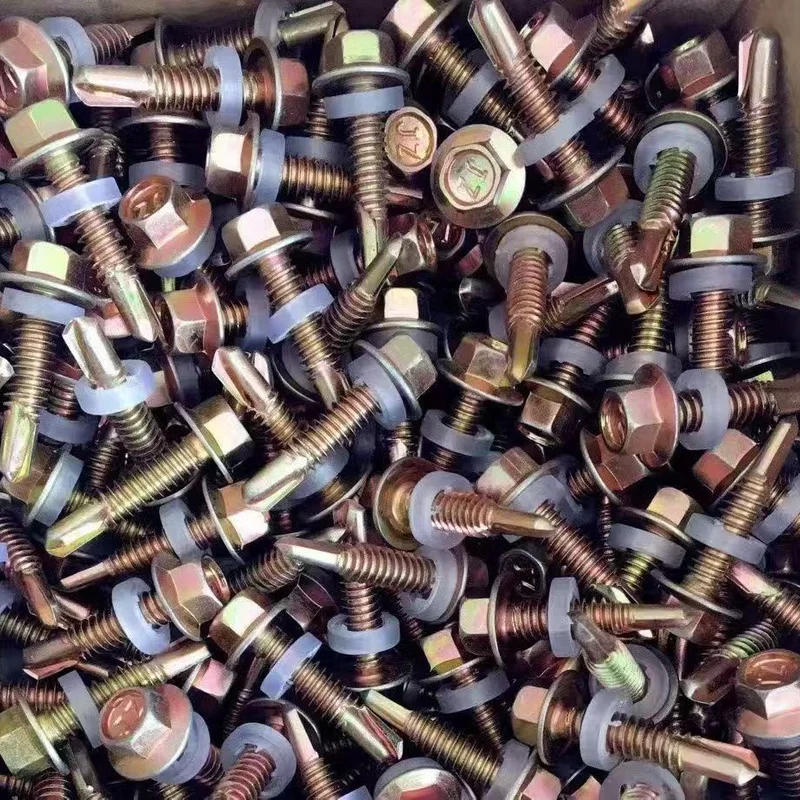
What Must Be Verified Before Ordering GB/T 15856.4 Screws?
Before placing an order for hexagon flange head self-drilling screws conforming to GB/T 15856.4, buyers must confirm the exact dimensional and material requirements, verify the applicable standard revision, and ensure the supplier can provide the necessary documentation. The standard itself is closely aligned with ISO 15480, but direct equivalence should not be assumed without checking the specific edition and any national deviations.
Confirm the Standard and Its Relationship to ISO 15480
GB/T 15856.4 specifies hexagon flange head self-drilling screws with tapping screw threads. It is technically based on ISO 15480, but buyers should not treat them as identical. Key points to verify:
- Standard year of issue: GB/T 15856.4 was published in different years (e.g., 1995, 2002). Confirm which version applies to your order, as dimensions or tolerances may differ.
- ISO 15480 alignment: While the GB/T standard is derived from ISO 15480, there may be differences in material grades, plating requirements, or testing methods. Request a declaration of conformity to the specific standard revision.
- Regulatory acceptance: If the screws are for use in regulated industries, check whether GB/T 15856.4 is accepted as equivalent to ISO 15480 by the relevant authority.
Specify Dimensions and Tolerances Clearly
Self-drilling screws are defined by thread size, length, and drill point capacity. For GB/T 15856.4, the following must be explicitly agreed upon:
- Thread diameter (d): Standard sizes range from ST2.9 to ST6.3. Confirm the exact nominal diameter and thread type (e.g., ST4.2).
- Nominal length (L): Length is measured from under the flange to the end of the drill point. Ensure the specified length matches your assembly thickness, including the drill point protrusion.
- Drill point number: The standard defines drill point sizes (e.g., No. 2, No. 3) that correspond to the maximum drilling capacity in steel. Verify that the selected point can drill through your total material stack without bottoming out.
- Flange and head dimensions: The hexagon flange head has specific across-flats, flange diameter, and thickness. If you require a particular wrench size or bearing surface, confirm these dimensions against the standard tables.
Material, Hardness, and Surface Finish
GB/T 15856.4 does not prescribe a single material or finish. Buyers must specify:
- Material grade: Common choices include case-hardened carbon steel (e.g., 20Mn, 15MnB) or stainless steel. The material must be capable of achieving the required core hardness (typically 270–390 HV) and surface hardness (min. 560 HV) after heat treatment.
- Case depth: For case-hardened screws, the standard specifies a minimum case depth based on thread size. Confirm that the supplier can meet this requirement.
- Surface finish: Options include zinc plating (with or without chromate conversion), zinc flake coating, or plain (oiled). Specify the corrosion resistance requirement (e.g., hours to white/red rust per ISO 9227) and any restricted substances (e.g., Cr6+ free).
- Hydrogen embrittlement risk: For high-strength screws with electroplated finishes, inquire about the supplier's baking process to prevent hydrogen-induced failure.
Performance and Testing Requirements
Self-drilling screws must meet functional requirements that are not always fully detailed in the dimensional standard. Discuss the following with the supplier:
- Drilling performance: The screw must drill through the specified material thickness within a defined time and without excessive wear. Request test data or agree on a sampling plan for incoming inspection.
- Tapping and drive torque: The screw must form a mating thread without stripping and be drivable to a specified torque. Confirm the acceptable torque range for your application.
- Pull-out and shear strength: If the joint is structural, request calculated or tested values based on the base material and screw size. Note that these values are not part of GB/T 15856.4 and must be separately validated.
Packaging, Marking, and Documentation
To avoid receiving mixed or non-conforming product, agree on:
- Lot traceability: Each container should be marked with the manufacturer's identification, standard designation, size, material, finish, and lot number.
- Certificates: Request a material test certificate (e.g., EN 10204 type 2.2 or 3.1) showing chemical composition, mechanical properties, and plating thickness.
- Inspection documents: If the screws are for critical applications, consider requiring a dimensional inspection report or a first article inspection (FAI) per your drawing.
Supplier Capability and Compliance
Finally, verify that the supplier has experience manufacturing to GB/T 15856.4 and can consistently meet your requirements:
- Production samples: Request samples from a production run, not just stock samples, to evaluate drilling performance and dimensional accuracy.
- Quality system: Confirm the supplier holds relevant certifications (e.g., ISO 9001) and has in-house testing capabilities for hardness, plating thickness, and drill testing.
- Minimum order quantity and lead time: For custom sizes or non-stock finishes, confirm the MOQ and delivery schedule. For example, our factory supplies hexagon flange head self-drilling screws per ISO 15480 with an MOQ of 1000 kg and a lead time of 15–25 days. Contact us to discuss your specific GB/T 15856.4 requirements.